Performance-Based & Open-Book Custodial Contracts: A Buyer's Guide
The short answer: A performance-based custodial contract pays for measured outcomes — a defined APPA cleanliness level, verified by scored inspections and physical testing — instead of buying a headcount and hoping. An open-book contract adds full cost transparency: the client sees every labor hour, supply dollar, and management fee, with no hidden margins. Together they convert the most common custodial failure mode — a low bid built on guessed staffing that unravels after award — into a partnership where both sides can see the same numbers and the same scores.
Why Traditional Custodial Contracts Disappoint
Most janitorial agreements are fixed-price task lists: sweep nightly, vacuum weekly, strip floors annually. The structure has three built-in failure points. First, nothing defines how clean the outcome must be, so enforcement collapses into complaint-driven arguments. Second, the price is only as honest as the staffing math behind it — and in a low-bid environment, the winning number is often the one that guessed lowest. Third, when the contractor under-delivers, the client's only levers are complaints and termination, both of which are expensive.
The fix isn't a tougher task list. It's changing what the contract buys.
What "Performance-Based" Actually Means
A performance-based program replaces the task list with three enforceable components:
- A measurable standard. Target APPA cleanliness levels assigned space-by-space (Level 1 in showcase areas, Level 2 in general space — see our APPA explainer).
- Continuous measurement. Scored inspections against written appearance descriptions — on CSS contracts these are continuous and overlapping, logged in a real-time, web-based system the client can access — plus physical metrics: ATP surface testing, slip meter readings against OSHA-referenced thresholds, and indoor air quality checks.
- A correction mechanism. A structured Root Cause Program that fixes deficiencies at their source (a workload gap, a training gap, a supply issue) rather than re-cleaning the same complaint every week.
Under this structure, quality is a dataset, not a debate. CSS's average inspected quality score across contracts is 96%, and every client can log in and check ours at any time — that visibility is the enforcement mechanism.
What "Open-Book" Adds
Open-book contracting exposes the entire cost build-up: labor hours by position and shift, wage and benefit rates, supplies, equipment amortization, and the management fee. Buyers sometimes assume transparency mainly protects them from overcharging — and it does — but its bigger value is what it makes possible:
- Budget-neutral redesign. When both parties can see the hours, service can be shifted mid-contract — more attention to the admissions lobby, less to a low-use storage wing — while keeping total spend neutral to the awarded price. No change orders, no renegotiation theater.
- Honest scope conversations. If a client wants Level 1 in more spaces, the cost of that choice is visible arithmetic, not a quote to be haggled over.
- Trust that compounds. Partnerships built on visible numbers renew. CSS's average contract relationship exceeds two full contract periods, with a re-bid win rate above 75% — retention that is only possible when clients can verify, year after year, that they're getting what they pay for.
Comparing the Three Models
| Traditional Fixed-Price | Performance-Based | Performance-Based + Open-Book | |
|---|---|---|---|
| What you buy | A task list | A measured cleanliness outcome | A measured outcome with transparent costs |
| Quality enforcement | Complaints | Scored inspections + physical metrics | Scored inspections + physical metrics |
| Cost visibility | Bottom line only | Bottom line only | Full build-up: hours, rates, supplies, fee |
| Mid-contract flexibility | Change orders | Limited | Budget-neutral service redesign |
| Incentive alignment | Contractor profits by cutting effort | Contractor profits by hitting scores | Both parties optimize the same visible plan |
Five Things to Require in Your Next Solicitation
- Work-loaded pricing. Require bidders to show APPA-based production-rate math, FTEs by building and shift, and relief factors for absences. A price without this math is a guess.
- APPA levels by space type, with scored inspections against them after award.
- Client-accessible quality data. Real-time inspection scores and deficiency trends, not quarterly summaries.
- Physical verification metrics. ATP, slip meter, and indoor air quality testing with defined thresholds.
- A technology refresh commitment. The program should improve during the term — sensors, autonomous equipment, AI-driven scheduling — not freeze at award. (See how modern programs use AI and sensors.)
A Note on Choosing Partners
Structure matters, but so does intent. CSS is deliberately selective: we look for clients who want an honest assessment and a planned path to their goals, because performance-based, open-book contracting only works when both sides actually want the numbers on the table. If a contractor resists transparency in the proposal stage, that tells you how the contract will go.
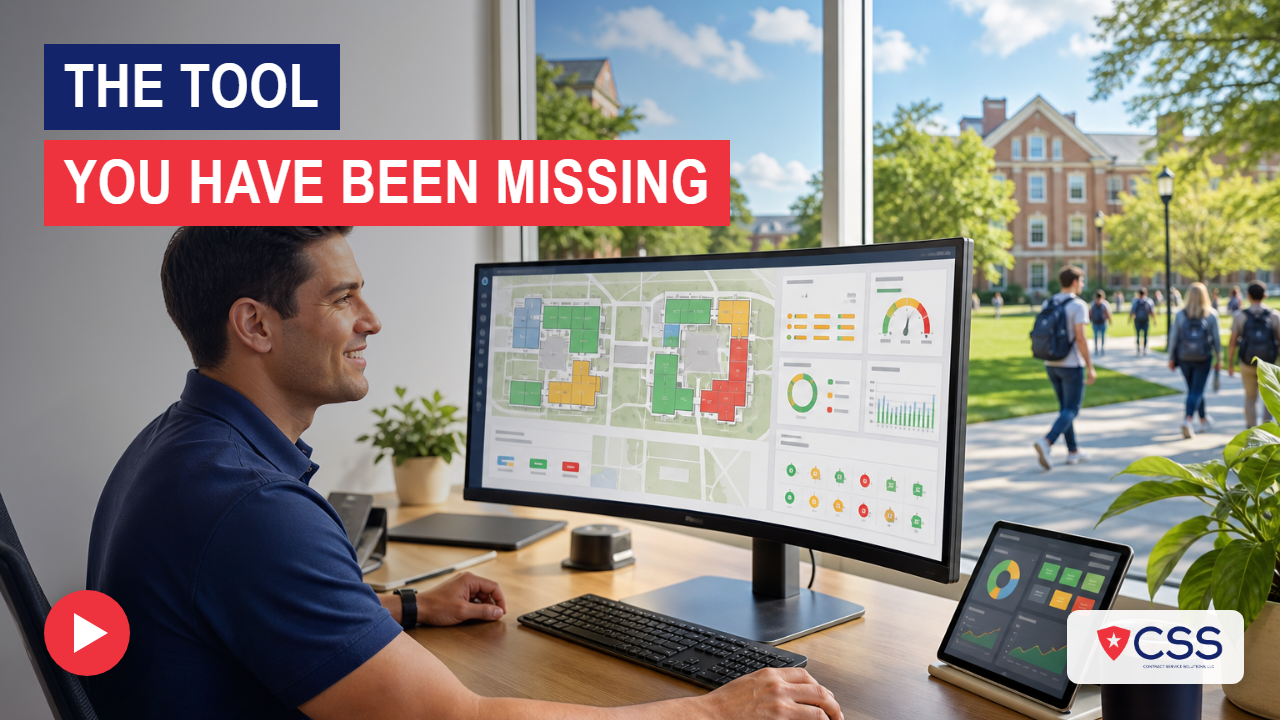 Watch the episode · 7 minFacility Hub Live: What If Your Whole Custodial Program Fit on One Screen?
Want a contract structure that protects you?
CSS proposes open-book, performance-based custodial programs for federal, higher-education, and institutional clients nationwide. Certified SBE.
Request a Quote Watch the Video Series