How AI, Sensors, and Autonomous Equipment Are Changing Custodial Services
The short answer: Custodial services are moving from fixed routes and clipboards to what CSS calls the "Living Facility" model: occupancy sensors flex staffing to where buildings are actually being used, autonomous scrubbers handle repetitive floor work with validated trip reports, and AI supports scheduling, reporting, and quality assessment. For buyers, the payoff is higher, more consistent service in the spaces people notice — at a long-run cost that trends down instead of up. The question to ask any custodial contractor is no longer "how many people?" but "how will your program be better in year three than in year one?"
Why the Old Model Breaks
Traditional custodial programs are built on two fictions: that every space is used the same way every day, and that a supervisor with a clipboard can verify thousands of tasks. Neither survives contact with a real campus. A lecture hall may host 600 students on Tuesday and sit empty on Friday; a first-floor restroom may see ten times the traffic of one on the fourth floor. A fixed route treats them identically — which means labor is wasted in empty rooms while high-traffic spaces generate complaints.
Meanwhile, absenteeism silently deletes coverage. When a custodian on a fixed route calls out and there's no engineered relief plan, that route simply doesn't happen. Technology attacks both problems at once.
The Three Layers of a Modern Program
1. Sensors: staff to demand, not to habit
Usage and occupancy sensors in restrooms, conference rooms, and transient spaces report what was actually used. That data drives dispatch: heavily used spaces get serviced sooner and more often; empty ones stop consuming labor. It also enables prediction — identifying a service need before it becomes a complaint call. On CSS contracts, sensor data feeds directly into daily assignments, which is a large part of why our average inspected quality score runs at 96%. This sensor-first, staff-to-demand approach is the heart of the Living Facility model — and on college campuses we call it The Living Campus, which is also the name of our weekly video series that walks through the model episode by episode.
2. Autonomous equipment: consistency you can audit
Autonomous scrubbers and sweepers take over the long, repetitive corridor and open-floor runs. They don't call in sick, they don't skip the far wing at the end of a shift, and — critically for institutional buyers — they produce validated trip reports: proof of exactly what was cleaned, when, and for how long. The trained custodians they free up are reassigned to detail work, restrooms, and disinfection — the tasks that actually drive occupant satisfaction. Autonomy doesn't shrink the human team's value; it concentrates it where machines can't go.
3. AI: scheduling, reporting, and quality at scale
AI now supports the management layer: schedule optimization around academic calendars and events, automated reporting and metrics, and quality assessments that flag trends a human reviewer would miss. Combined with a real-time, web-based inspection system that clients can log into, it turns quality from an assertion into a dataset — inspection scores, deficiency trends, response times, all visible to the customer.
The Metrics That Keep Everyone Honest
Technology only matters if outcomes are measured. A modern program should report against hard, physical metrics, not just checklists:
- ATP surface testing — a luminometer measures biological residue in seconds, verifying that "cleaned" means sanitized, not just wiped.
- Slip meter testing — floor traction measured against OSHA-referenced thresholds, turning slip-and-fall risk into a tracked number.
- Indoor air quality testing — particulate monitoring down to the three-micron level, which reflects real dusting and filtration performance.
- Service call response tracking — every request timestamped from call to closure.
These are the numbers we put in front of clients on CSS contracts, alongside continuous overlapping inspections. When results are visible in real time, a Root Cause Program can permanently fix a deficiency at its source instead of re-cleaning the symptom every week.
What This Means for Your Next RFP
Most custodial proposals now mention "innovation." Few commit to it contractually. Three questions separate the two:
- What technology is deployed on day one? Named equipment and sensor coverage, not intentions.
- Can we see the data? Trip reports, inspection scores, and sensor dashboards should be client-accessible, not summarized quarterly.
- How does the program improve mid-contract? CSS's standing commitment is that clients will not have the same service platform in five years that they have today — we evaluate and deploy new technology proactively, without the client having to ask. Anything less means your program is frozen at award and ages every year after.
Staffing math still underpins all of it — sensors and robots optimize a plan, they don't replace one. For how the baseline plan gets built, see APPA Cleaning Levels Explained, and for how to structure the deal itself, see our buyer's guide to performance-based, open-book contracts.
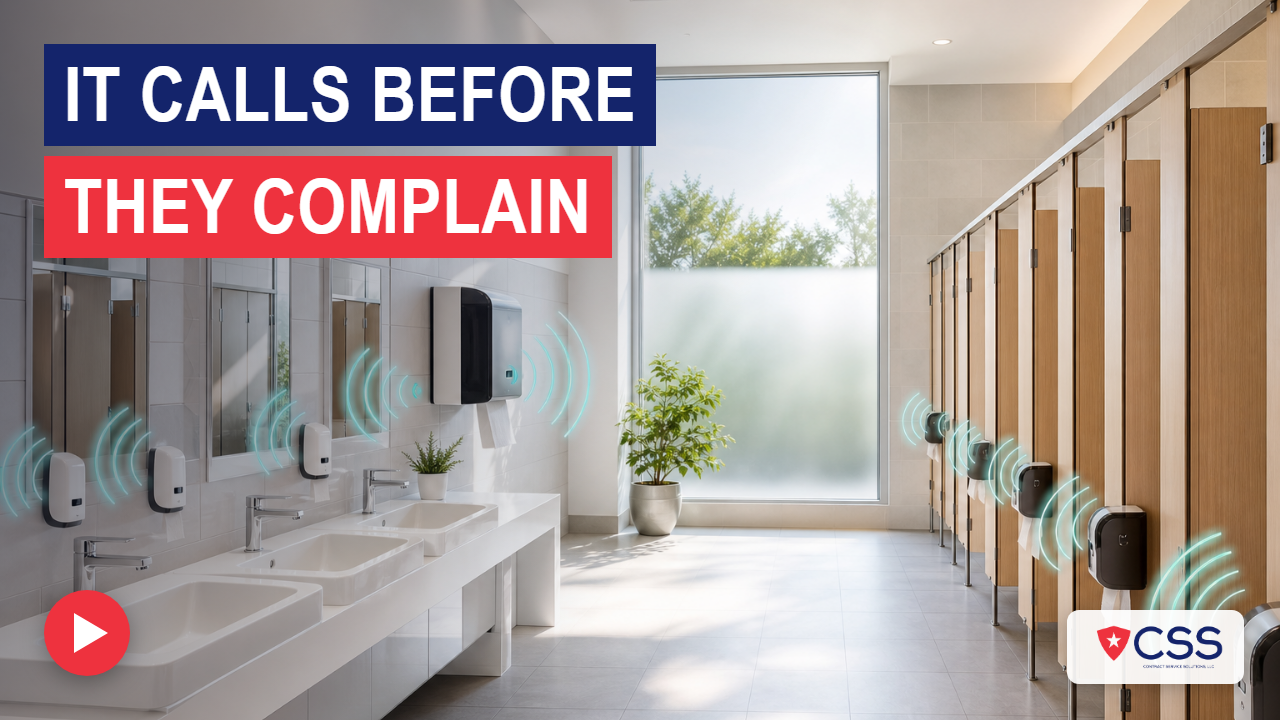 Watch the episode · 7 minThe Restroom That Asks for Service: What If It Flagged Itself Before Anyone Complained?
See what a Living Facility program looks like
CSS deploys sensor-based staffing, autonomous equipment, and AI-enhanced quality control for federal, higher-education, and institutional campuses nationwide.
Request a Quote Watch the Video Series