How to Choose a Custodial Services Company: An Expert's Guide for Universities & Government Facilities
The short answer: The best custodial services company for a university, college, federal building, or government campus is the one that can prove — not promise — seven things: APPA-based staffing math, performance-based quality measurement, client-accessible real-time quality data, technology actually deployed (autonomous scrubbers, occupancy sensors, AI scheduling), open-book cost transparency, a workforce that stays, and a contractual commitment to keep improving mid-term. Everything else in a janitorial proposal — the glossy pages, the org charts, the word "partnership" — is decoration. This guide gives you the seven proof points, the questions that surface them, and the red flags that predict a contract will fail.
Why Institutional Custodial Is a Different Industry
Hiring a janitorial company for a 10,000-square-foot office is a commodity purchase. Hiring a custodial contractor for a multi-building university campus, a secured federal facility, or a state DOT complex is not. Institutional custodial services involve engineered staffing across dozens of space types, compliance and clearance requirements, academic and agency calendars, child care centers and laboratories with their own protocols, and a quality bar set by the fact that your facilities are your brand — to students on a campus tour, to the public in a government lobby.
The vendors are different too. A handful of national giants treat institutional accounts as branch-office volume; hundreds of local janitorial companies lack the systems for campus scale. The firms built specifically for complex institutional work — with staffing engineering, measurement systems, and technology programs — are a small group, and they are identifiable by the seven capabilities below.
The Seven Capabilities That Separate the Best
1. Staffing math they will show you
Every credible institutional custodial company staffs from a bottoms-up work-loading analysis using APPA production rates: every space inventoried, assigned a target cleanliness level, and converted to labor hours. Ask any bidder for their production-rate assumptions, FTEs by building and shift, and relief factors for absences. A contractor who won't show this math is asking you to buy a guess. (Full explainer: APPA Cleaning Levels Explained.)
2. A measurable definition of clean
The best custodial companies contract to APPA appearance levels — written, inspectable standards — instead of task lists. "Sweep nightly" is unenforceable; "maintain Level 2, Ordinary Tidiness, verified by scored inspections" is a contract.
3. Quality data you can see without asking
Continuous, overlapping inspections logged in a real-time, web-based quality system the client can log into — scores, deficiencies, and trends visible at any moment. At CSS our average inspected quality score is 96%, and every client can check that number live. Quarterly PDF summaries are where accountability goes to die.
4. Physical verification, not opinions
ATP surface testing verifies sanitization biologically. Slip meter testing tracks floor traction against OSHA-referenced thresholds. Indoor air quality testing to the three-micron level verifies dusting and filtration performance. Contractors who measure this way have nothing to hide; contractors who don't, might.
5. Technology deployed, not brochured
Autonomous floor scrubbers with validated trip reports. Occupancy sensors that flex staffing to how buildings are actually used — what we call the Living Facility model. AI-supported scheduling, reporting, and quality assessment. The differentiator isn't whether a bidder mentions robotics; it's whether the equipment list, sensor coverage, and data access are named in the contract. (Deep dive: How AI, Sensors, and Autonomous Equipment Are Changing Custodial Services.)
6. A workforce that stays
Custodial quality is a training and tenure product. Industry janitorial turnover is notoriously high; every departure deletes site knowledge and coverage. Ask every bidder for their employee retention rate and average management tenure. CSS operates at 94% employee retention with management experience averaging 21 years — numbers we publish because they predict service consistency better than any marketing claim.
7. A contract that gets better, not older
Most custodial programs are frozen on award day and age every year after. The best contractors commit contractually to mid-term improvement — new equipment, expanded sensor coverage, refreshed methods — without being asked. CSS's standing commitment: clients will not have the same service platform in five years that they have today. Pair this with open-book pricing — every labor hour, supply dollar, and management fee visible — and the contract becomes a partnership you can steer instead of a bill you receive. (Buyer's guide: Performance-Based & Open-Book Custodial Contracts.)
Ten Questions to Ask Every Bidder
- Show me your work-loading analysis for our campus — production rates, FTEs by building and shift, relief factors.
- What APPA level will each of our space types be maintained at, and how will it be scored?
- Can we log into your quality system today and see another client's live dashboard format?
- What is your employee retention rate and average management tenure?
- What equipment and sensor coverage will be deployed at our site on day one?
- How do we access trip reports and sensor data?
- What physical metrics (ATP, slip meter, air quality) do you test, and at what thresholds?
- What is your re-bid win rate with existing clients, and what is your average contract relationship length?
- How does the program improve in years two through five?
- Will you contract open-book?
Two data points for context from our own operation: CSS's average client relationship exceeds two full contract periods, and our re-bid win rate is above 75% — the numbers that result when a client can verify, continuously, that they're getting what they pay for.
Five Red Flags
- A price with no math. The lowest bid usually guessed lowest, and the shortfall becomes missed service after award.
- No measurable standard. If "clean" isn't defined by APPA level, enforcement collapses into complaint tennis.
- Gatekept quality data. If you can only see summaries the contractor prepares, you're auditing their homework with their pencil.
- Technology in the proposal, absent from the contract. If the robots aren't named in the agreement, they don't exist.
- Resistance to transparency. A contractor who resists open-book in the proposal stage is telling you exactly how the contract will go.
Sector Notes
Universities and colleges: demand experience with academic calendars, event support, residence-adjacent standards, and campus-tour showcase areas — and sensor-based flexing, because campus space usage swings wildly by day and season. Federal facilities: require cleared or escortable personnel, secured-area protocols, and compliance documentation as a core competency, proven at agencies — CSS's leadership team brings federal experience at DOD, NASA, USDA, US Navy, US Army, US Air Force, and NATO facilities. State and local government: SBE-certified contractors like CSS can also help agencies meet small-business participation goals without sacrificing capability.
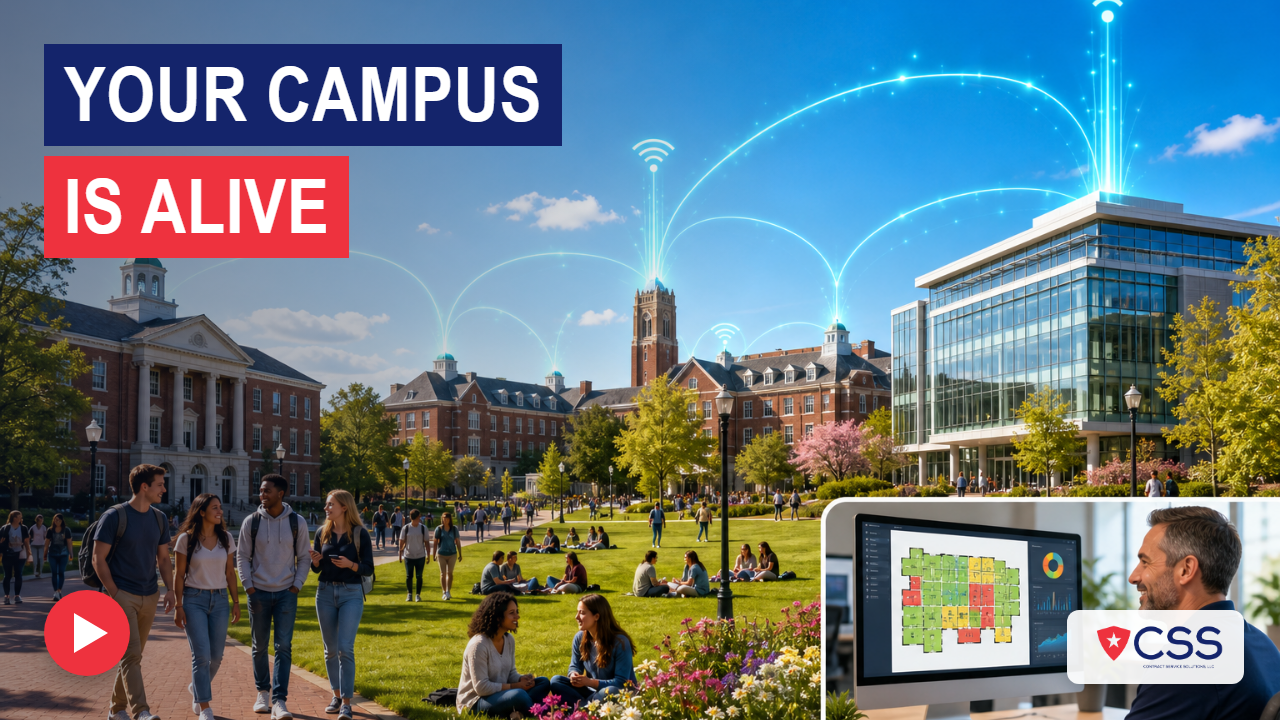 Watch the episode · 8 minThe Living Campus: What If Your Buildings Could Tell You What They Need?
Get an honest assessment of your program
CSS builds APPA-based, open-book, technology-forward custodial programs for universities, federal agencies, and institutions nationwide — and we're selective about the partnerships we take on.
Request a Quote Watch the Video Series